

A2 Milk Market Set to Reach USD 90.77 Billion by 2035 at 17.75% CAGR as Health-Focused Dairy Demand Accelerates
A2 Milk Market
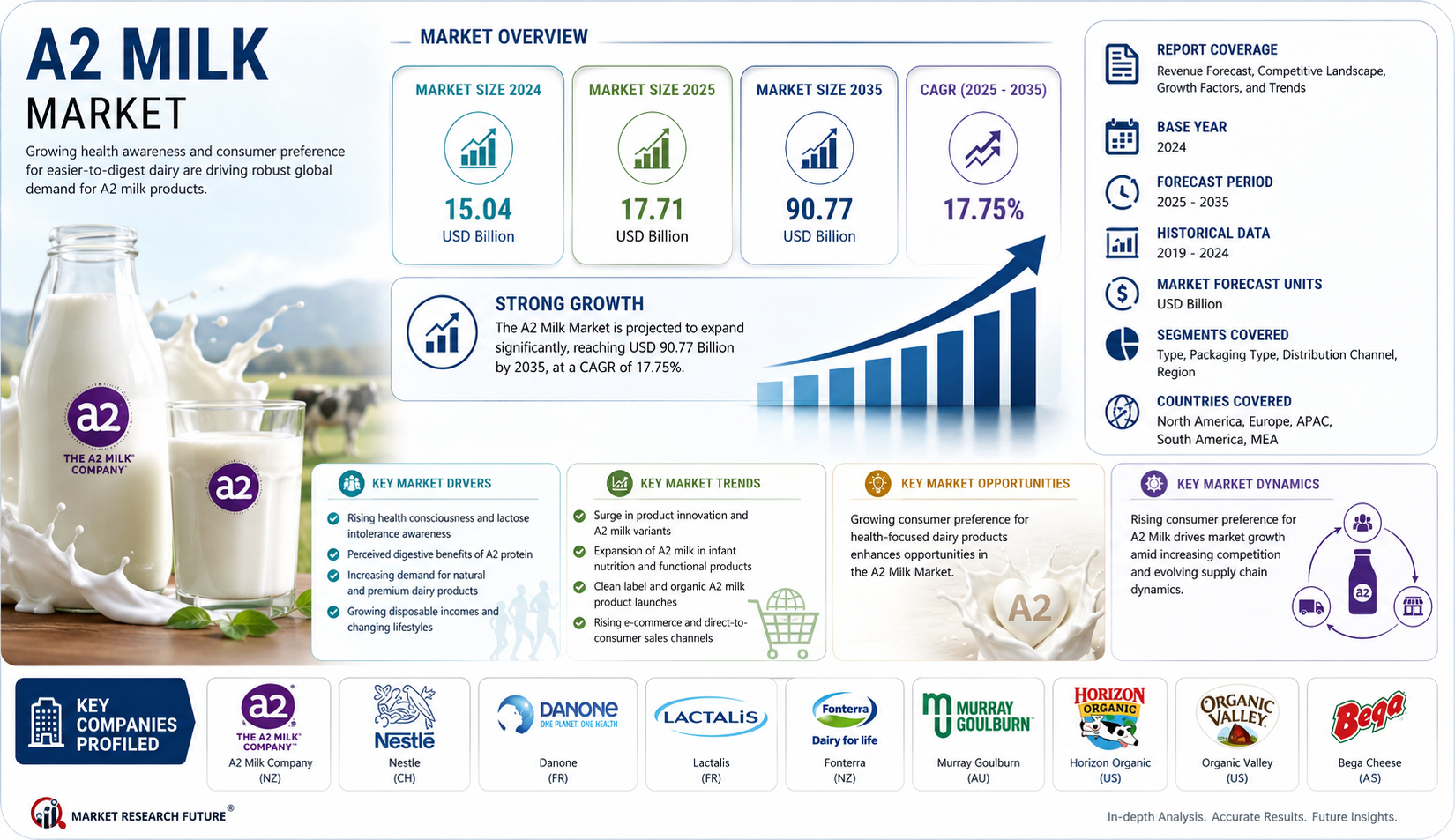
The A2 Milk Market is projected to grow from USD 17.71 billion in 2025 to USD 90.77 billion by 2035, driven by health-focused dairy demand.
A2 milk caused fewer symptoms and lower gas production in verified lactose intolerant subjects.”
NEW YORK, NY, UNITED STATES, August 28, 2026 /EINPresswire.com/ -- — Ramakrishnan et al.
The A2 Milk Market is entering a high-growth phase as consumers increasingly seek dairy products associated with digestive comfort, nutritional value, and differentiated protein profiles. According to the provided market assessment, the market is valued at USD 15.04 billion in 2024 and is projected to reach USD 17.71 billion in 2025. By 2035, the market is expected to reach USD 90.77 billion, representing a 17.75% CAGR from 2025 to 2035. The expansion reflects changing perceptions of conventional dairy, growing interest in specialized nutrition, premiumization, and rising consumer awareness of A1 and A2 beta-casein.
Competitive activity is becoming broader as established dairy companies and specialized A2-focused businesses compete across fresh milk, infant nutrition, powdered products, and other dairy applications. The A2 Milk Company (NZ) remains an important specialist in the category, while Nestle (CH), Danone (FR), Lactalis (FR), Fonterra (NZ), Murray Goulburn (AU), Horizon Organic (US), Organic Valley (US), and Bega Cheese (AU) represent major companies profiled within the competitive landscape. Competition is increasingly centered on product differentiation, sourcing of A2-producing cows, quality assurance, distribution reach, research support, and the ability to command premium pricing.
Free Sample Copy - Access A Complimentary Copy of Our Report to Explore Its Content and Insights
https://www.marketresearchfuture.com/sample_request/6495
Market Drivers and Growth Dynamics
The strongest growth driver is the increasing consumer preference for health-focused dairy products. Consumers are becoming more attentive to the composition of milk proteins rather than considering dairy simply as a commodity. A2 milk contains the A2 variant of beta-casein and is produced from cows selected to naturally produce A2 beta-casein rather than the A1/A2 combination found in much conventional milk. This distinction has created a premium category positioned around digestive tolerance and specialized nutrition.
Scientific research has contributed to market awareness. Randomized controlled studies have reported fewer gastrointestinal symptoms in some lactose maldigesters consuming A2-only milk compared with conventional milk containing both A1 and A2 beta-casein. However, A2 milk should not be considered lactose-free, and evidence concerning broader health claims remains less conclusive. A systematic review found moderate certainty regarding digestive symptoms but substantially lower certainty for other proposed health outcomes.
Another important factor is premiumization within dairy. A2 milk generally occupies a higher-value position than standard milk, allowing producers and retailers to target consumers willing to pay for differentiated nutritional attributes. Rising disposable incomes, urbanization, greater exposure to global food trends, and increased interest in clean-label and minimally processed products can further support category development.
A2 Milk Market Segmentation Analysis
By Type
The type segment encompasses different A2 milk formulations designed for varying consumer requirements. Whole A2 milk is likely to remain important because it retains a familiar sensory profile and is positioned as a nutrient-dense dairy option. Reduced-fat and skimmed variants can attract consumers seeking lower-fat alternatives while maintaining the A2 protein profile.
Flavored A2 milk and specialized formulations provide opportunities to expand beyond traditional white milk. Manufacturers can use chocolate, vanilla, or other flavor profiles to appeal to younger consumers and increase consumption occasions. Powdered A2 milk also has relevance in markets where shelf stability, transportation, and infant nutrition are important considerations.
By Packaging Type
Packaging plays a significant role in preserving product quality, extending shelf life, and supporting convenience. Cartons are widely suited to household consumption and refrigerated retail channels, while bottles can offer portability and premium shelf presentation. Single-serve formats are particularly relevant to convenience stores, offices, schools, and on-the-go consumption.
Long-life and aseptic packaging can also expand distribution opportunities by reducing dependence on continuous cold-chain infrastructure. Sustainable packaging is becoming increasingly important as consumers and retailers evaluate the environmental footprint of dairy products alongside nutritional attributes.
By Distribution Channel
The distribution channel segment includes supermarkets and hypermarkets, convenience stores, specialty retailers, online channels, and foodservice outlets. Supermarkets and hypermarkets remain critical because they provide broad consumer access and dedicated refrigerated shelf space for premium dairy.
Specialty stores can serve consumers specifically searching for organic, natural, functional, or premium dairy products. Meanwhile, e-commerce is becoming increasingly relevant for subscription purchasing, home delivery, and specialized nutrition products. Online channels can also help brands educate consumers about A2 beta-casein and differentiate their products through detailed product information.
Foodservice represents another opportunity as cafés, restaurants, hospitals, wellness centers, and institutional buyers incorporate differentiated milk into beverages and food preparation.
Regional Market Outlook
North America represents a significant opportunity because of established premium dairy consumption, strong retail infrastructure, and growing interest in functional and specialized foods. Product education and premium positioning will remain important for broader adoption.
Europe has a mature dairy industry and consumers familiar with premium, organic, and specialty milk categories. Regulatory requirements, sustainability expectations, and competition from plant-based beverages may influence market development.
Asia-Pacific (APAC) is expected to remain strategically important due to population size, expanding middle-class consumption, increasing interest in infant nutrition, and strong demand for premium dairy products in markets such as China and other Asian economies. The A2 Milk Company, for example, identifies Australia, New Zealand, China, the United States, Canada, South Korea, Singapore, and emerging Asian markets among its areas of activity.
South America offers opportunities through expanding premium food categories and growing dairy consumption, although affordability and local supply conditions can influence penetration. Middle East & Africa (MEA) can benefit from premium imported dairy, urbanization, modern retail development, and increasing interest in specialized nutrition, while cold-chain infrastructure remains an important consideration.
Key Market Opportunities
A major opportunity lies in extending A2 milk from conventional liquid milk into infant nutrition, yogurt, cheese, nutritional beverages, powdered dairy, and food ingredients. Product diversification can increase consumption occasions while reducing reliance on a single category.
Infant nutrition is particularly significant because research into A2-type protein formulas is becoming more developed. In July 2026, The A2 Milk Company reported a randomized, double-blinded growth-monitoring study in which A1-protein-free formula supported normal growth and safety over 16 weeks in healthy full-term U.S. infants. The company stated that the study met predefined U.S. FDA criteria for new formula registration.
Industry Developments
1. New clinical evidence presented at NUTRITION 2026: In July 2026, The A2 Milk Company presented new research covering infant growth and safety, protein utilization, digestive tolerance, and the gut-brain axis at the American Society for Nutrition's NUTRITION 2026 meeting. The development reflects the industry's increasing emphasis on building a scientific evidence base around beta-casein.
2. Expansion of A2-focused scientific research: The company's 2026 research program included studies led independently by investigators at Purdue University and Nova Southeastern University, broadening investigation into digestive tolerance, protein utilization, and other physiological outcomes. This continued research activity may influence future product development, consumer education, and regulatory discussions surrounding A2-type dairy.
Challenges and Competitive Landscape
Despite strong growth potential, the market faces challenges. A2 milk requires specialized herd selection and supply-chain management because producers need access to cows capable of producing A2 beta-casein. Maintaining consistent sourcing can increase operational complexity and costs. Premium pricing can also limit adoption among price-sensitive consumers.
The competitive landscape is therefore likely to evolve around farmer networks, certification and testing, processing capabilities, brand trust, scientific substantiation, geographic reach, and product innovation. The A2 Milk Company has a specialized category position, while larger dairy groups such as Nestle, Danone, Lactalis, and Fonterra can leverage broader manufacturing and distribution capabilities. Companies such as Murray Goulburn, Horizon Organic, Organic Valley, and Bega Cheese add further competitive depth across regional dairy markets and specialty segments.
Future Outlook
The A2 Milk Market is positioned for substantial expansion during the 2025–2035 forecast period. Growth from USD 17.71 billion in 2025 to USD 90.77 billion by 2035 reflects a projected 17.75% CAGR, supported by health-oriented purchasing behavior, premium dairy consumption, product diversification, and growing scientific attention to A2 beta-casein.
Over the longer term, market success will depend on whether producers can translate consumer interest into sustained repeat purchases while maintaining transparent sourcing, competitive pricing, reliable supply, and scientifically responsible product communication. As A2 milk moves from a niche dairy proposition toward a broader specialized-nutrition category, segmentation, innovation, and regional market strategies will become increasingly important.
FAQs
1. Is A2 milk the same as lactose-free milk?
No. A2 milk contains lactose unless it is specifically formulated as lactose-free. Its primary distinction is the type of beta-casein protein rather than the absence of lactose.
2. What is driving the growth of the A2 Milk Market?
The primary drivers include rising consumer preference for health-focused dairy, interest in digestive comfort, premiumization, product innovation, expanding distribution, and increasing research into A2 beta-casein.
Read Our Related Research Report
Milk Protein Market -
https://www.marketresearchfuture.com/reports/milk-protein-market-2322
Soy Milk Market -
https://www.marketresearchfuture.com/reports/soy-milk-market-4453
Oat Milk Market -
https://www.marketresearchfuture.com/reports/oat-milk-market-10216
Probiotic Fermented Milk Market -
https://www.marketresearchfuture.com/reports/probiotic-fermented-milk-market-37648
Skim Milk Powder Market -
https://www.marketresearchfuture.com/reports/skim-milk-powder-market-2298
Sagar Kadam
Market Research Future
+1 628-258-0071
email us here
Legal Disclaimer:
EIN Presswire provides this news content "as is" without warranty of any kind. We do not accept any responsibility or liability for the accuracy, content, images, videos, licenses, completeness, legality, or reliability of the information contained in this article. If you have any complaints or copyright issues related to this article, kindly contact the author above.
