

Mints Market Reaches USD 12.71 Billion by 2035 at 5.9% CAGR as Functional and Online Retail Drive Growth
Mints Market
Mints market is projected to reach USD 12.71 billion by 2035, driven by functional products, sugar-free formats, flavor innovation, and online retail growth.
Innovation is increasingly shifting mints from simple confectionery toward portable refreshment and functional experiences.”
NEW YORK, NY, UNITED STATES, August 27, 2026 /EINPresswire.com/ -- — Market Industry Analysis
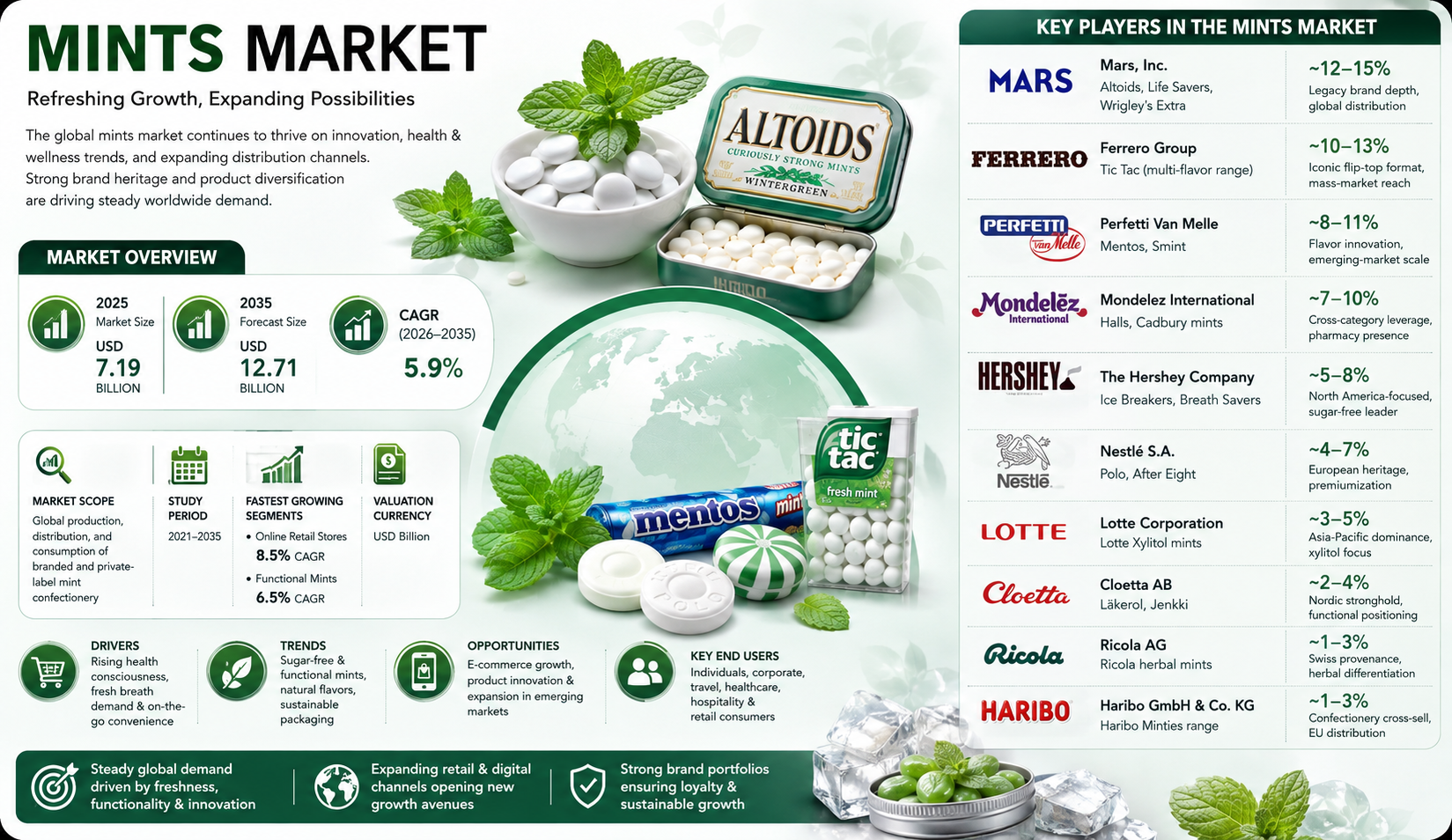
The global Mints Market is entering a period of steady expansion as consumers increasingly seek convenient products that combine confectionery enjoyment with breath-freshening and functional benefits. The market, covering branded and private-label mint confectionery across production, distribution, and consumption, is valued at USD 7.19 billion in 2025 and is projected to reach USD 12.71 billion by 2035, expanding at a 5.9% CAGR from 2026 to 2035. Demand is being supported by the portability of mints, frequent impulse purchases, growing interest in sugar-free alternatives, and product development around freshness and wellness-oriented attributes.
Competitive intensity remains high because established confectionery groups possess extensive distribution networks, recognizable brands, and significant product-development capabilities. Mars, Inc. leads the competitive landscape with an estimated 12–15% revenue share, supported by Altoids, Life Savers and its broader Wrigley portfolio. Ferrero Group, with approximately 10–13%, benefits from Tic Tac's global recognition and distinctive flip-top packaging. Perfetti Van Melle accounts for an estimated 8–11%, with Mentos and Smint positioned around flavor innovation and portability. Mondelez International holds approximately 7–10%, while The Hershey Company represents roughly 5–8%, particularly through its sugar-free ICE BREAKERS and Breath Savers portfolio. Other significant participants include Nestlé, Lotte Corporation, Cloetta, Ricola and Haribo.
Free Sample Copy - Access A Complimentary Copy of Our Report to Explore Its Content and Insights
https://www.marketresearchfuture.com/sample_request/22606
Market Dynamics and Key Growth Drivers
One of the strongest drivers is the evolution of mints from traditional breath-freshening candies into multifunctional products. Consumers increasingly encounter sugar-free, long-lasting freshness, herbal, vitamin-enriched and other differentiated propositions. This is particularly relevant as manufacturers attempt to increase consumption occasions beyond after-meal breath freshening. Functional Mints are projected to expand at a 6.5% CAGR, making them one of the most attractive areas of the market. Products incorporating ingredients such as vitamins, botanical extracts, herbal blends and specialized freshness systems can command greater consumer attention while creating differentiation in an otherwise mature confectionery category.
Another important driver is the expansion of sugar-free mints. Sugar-free formulations allow manufacturers to address consumers attempting to reduce conventional sugar intake while retaining sweetness and cooling sensations. The development of sugar alcohol-based formulations has also enabled brands to maintain convenient low-sugar positioning. For example, Hershey's ICE BREAKERS portfolio is entirely sugar-free, while individual products use ingredients such as sorbitol and maltitol.
Segment Analysis
Conventional and Sugar-Free Mints
Conventional mints continue to represent a significant part of global demand because of their affordability, familiarity and broad availability. Hard mints, chewy mints, compressed tablets and lozenges serve different consumption occasions, ranging from everyday breath freshening to post-meal use.
Sugar-free mints, however, are gaining strategic importance. They appeal to consumers seeking lower-sugar confectionery and have become a core platform for innovation. Manufacturers can also use sugar-free positioning to introduce stronger freshness profiles, new flavors and premium packaging without abandoning the traditional mint proposition.
Functional Mints
Functional mints represent one of the fastest-growing segments, with an estimated 6.5% CAGR. The category is broadening beyond basic freshness through vitamins, herbal ingredients, breath-care propositions and other functional attributes. Perfetti Van Melle, for example, has developed Mentos fruit mints with vitamins B6, B12 and C, demonstrating how the mint format can be adapted to wellness-oriented consumption.
The opportunity is particularly strong because mints are consumed in small quantities and carried easily. This makes the format suitable for discreet, on-the-go functional positioning. However, companies must balance functionality with taste, regulatory compliance and clear consumer communication.
Flavor and Product Innovation
Flavor innovation is another central competitive lever. Traditional peppermint and spearmint remain important, but fruity, citrus, berry and multi-flavor combinations are increasing product variety. Ferrero's Tic Tac Two, launched in 2025, introduced dual-flavor combinations in a sugar-free format, including Raspberry & Lemon and Strawberry & Lime in selected markets.
Perfetti Van Melle has also pursued flavor experimentation. In 2025, Mentos introduced a 14-flavor Discovery Roll combining fruity flavors including passion fruit, grapefruit, blackcurrant, blueberry, lime and pineapple in a single roll. Such launches illustrate how manufacturers are using variety and sensory novelty to encourage trial and repeat purchases.
Distribution Channels
Distribution remains highly fragmented across supermarkets, convenience stores, pharmacies, specialty retailers, travel retail and online platforms. Convenience stores remain important because mints are frequently purchased as impulse or immediate-consumption products.
However, Online Retail Stores are forecast to be the fastest-growing distribution segment, with an 8.5% CAGR. E-commerce allows brands to sell multipacks, variety packs and larger quantities while improving product discoverability. Digital channels also enable consumers to compare flavors, ingredients, functional claims and package sizes before purchase. Subscription-style replenishment and marketplace visibility could further support online penetration.
Packaging and Portability
Packaging is increasingly influencing purchasing behavior. Pocket-sized tins, flip-top containers, rolls, bottles and compact multipacks make mints particularly compatible with mobile lifestyles. Packaging also serves as a major branding mechanism because the product itself is small and relatively standardized.
Ferrero's Tic Tac format demonstrates the strategic importance of distinctive packaging, while brands such as Altoids have built considerable recognition around their metal tins. Mars describes Altoids peppermint tins as a leading U.S. mint format, highlighting how packaging can become part of long-term brand identity.
Regional and Consumer Trends
Developed markets continue to provide strong demand because of established mint consumption habits and high brand penetration. Europe benefits from strong heritage brands such as Polo, Smint, Läkerol and Ricola, while North America remains highly competitive across sugar-free, breath-freshening and flavored formats.
Asia-Pacific presents significant long-term opportunities because of expanding organized retail, increasing urbanization and the presence of strong regional players. Lotte's focus on xylitol mints illustrates the importance of sugar-free and oral-refreshment positioning in Asian markets. Emerging economies also provide opportunities for affordable single packs and smaller formats, although price sensitivity can constrain premiumization.
Competitive Landscape
The competitive structure is characterized by a combination of global confectionery conglomerates, regional specialists and private-label manufacturers. Mars benefits from a deep portfolio and international distribution, while Ferrero uses Tic Tac's distinctive identity and flavor development to compete across mass-market channels. Perfetti Van Melle has emphasized new formats, flavors and portability through Mentos and Smint.
Mondelez benefits from cross-category confectionery capabilities and the presence of Halls, while Hershey has developed a strong sugar-free position through ICE BREAKERS. Nestlé retains European heritage through Polo and premium confectionery associations through After Eight. Lotte focuses on xylitol and Asia-Pacific markets, while Cloetta emphasizes Nordic brands and functional positioning. Ricola differentiates through Swiss provenance and herbal formulations, and Haribo uses its broad confectionery distribution to support cross-category opportunities.
Two Recent Industry Developments
1. Ferrero expands sugar-free, multi-flavor innovation: In May 2025, Ferrero introduced Tic Tac Two, featuring two-layer, dual-flavor sugar-free mints. The launch demonstrates the industry's movement toward combining familiar mint formats with novel sensory experiences.
2. Perfetti Van Melle expands portable mint formats: In May 2026, Perfetti Van Melle introduced Mentos Cool Mints alongside new 10-piece Fresh Mint and Spearmint gum packs. The Cool Mints format uses a three-layer design and green tea extract, reinforcing the industry's emphasis on portability, freshness and differentiated product experiences.
Future Outlook
Through 2035, the Mints Market is expected to evolve from a conventional confectionery category toward a broader portable refreshment ecosystem. The combination of a 5.9% CAGR, rising functional-mint adoption and 8.5% growth in online retail points toward increasing product segmentation and channel diversification. Manufacturers are likely to compete through sugar-free formulations, premium ingredients, botanical and functional claims, unusual flavor combinations, compact packaging and digitally enabled distribution.
At the same time, established brands will continue benefiting from consumer familiarity and strong retail relationships. New entrants and private-label producers may find opportunities through niche formulations, natural ingredients and targeted functional propositions. Overall, the market's future growth will depend on how effectively companies balance affordability, taste, convenience, functionality and regulatory requirements while creating meaningful differentiation in an increasingly diverse confectionery environment.
FAQs
1. What is the projected size of the global Mints Market by 2035?
The global Mints Market is projected to reach USD 12.71 billion by 2035, compared with USD 7.19 billion in 2025, representing a 5.9% CAGR during 2026–2035.
2. Which segment is expected to grow fastest in the Mints Market?
Online Retail Stores are projected to be the fastest-growing distribution segment at an 8.5% CAGR, while Functional Mints are expected to grow at 6.5% CAGR, supported by demand for differentiated and wellness-oriented products.
Read Our Related Research Report
Sugar-Free Chewing Gum Market -
https://www.marketresearchfuture.com/reports/sugar-free-chewing-gum-market-10400
Digestive Health Drinks Market -
https://www.marketresearchfuture.com/reports/digestive-health-drinks-market-11535
Basil Extract Market -
https://www.marketresearchfuture.com/reports/basil-extract-market-31898
Sagar Kadam
Market Research Future
+1 628-258-0071
email us here
Legal Disclaimer:
EIN Presswire provides this news content "as is" without warranty of any kind. We do not accept any responsibility or liability for the accuracy, content, images, videos, licenses, completeness, legality, or reliability of the information contained in this article. If you have any complaints or copyright issues related to this article, kindly contact the author above.
