
Moisture Barrier Performance and Structural Evaluation: Insights from an Advanced Biodegradable Cellulose Bags Factory
HUIZHOU, GUANGDONG, CHINA, July 24, 2026 /EINPresswire.com/ -- Biodegradable cellulose bags often face evaluation through a single lens, whether sustainability credentials or visual appeal, when their actual performance varies considerably across coating choices, film thickness, and structural construction. A bag suitable for short-term floral wrapping may fail entirely when repurposed for six-month dry food storage, while a coated cellulose pouch designed for confectionery may decompose far slower than its uncoated counterpart in a backyard compost pile. The performance documentation provided by an Advanced Biodegradable Cellulose Bags Factory therefore matters more for application matching than for marketing positioning. This analysis examines moisture barrier behavior, degradation timelines, and structural integrity through measurable performance data rather than sustainability narrative.
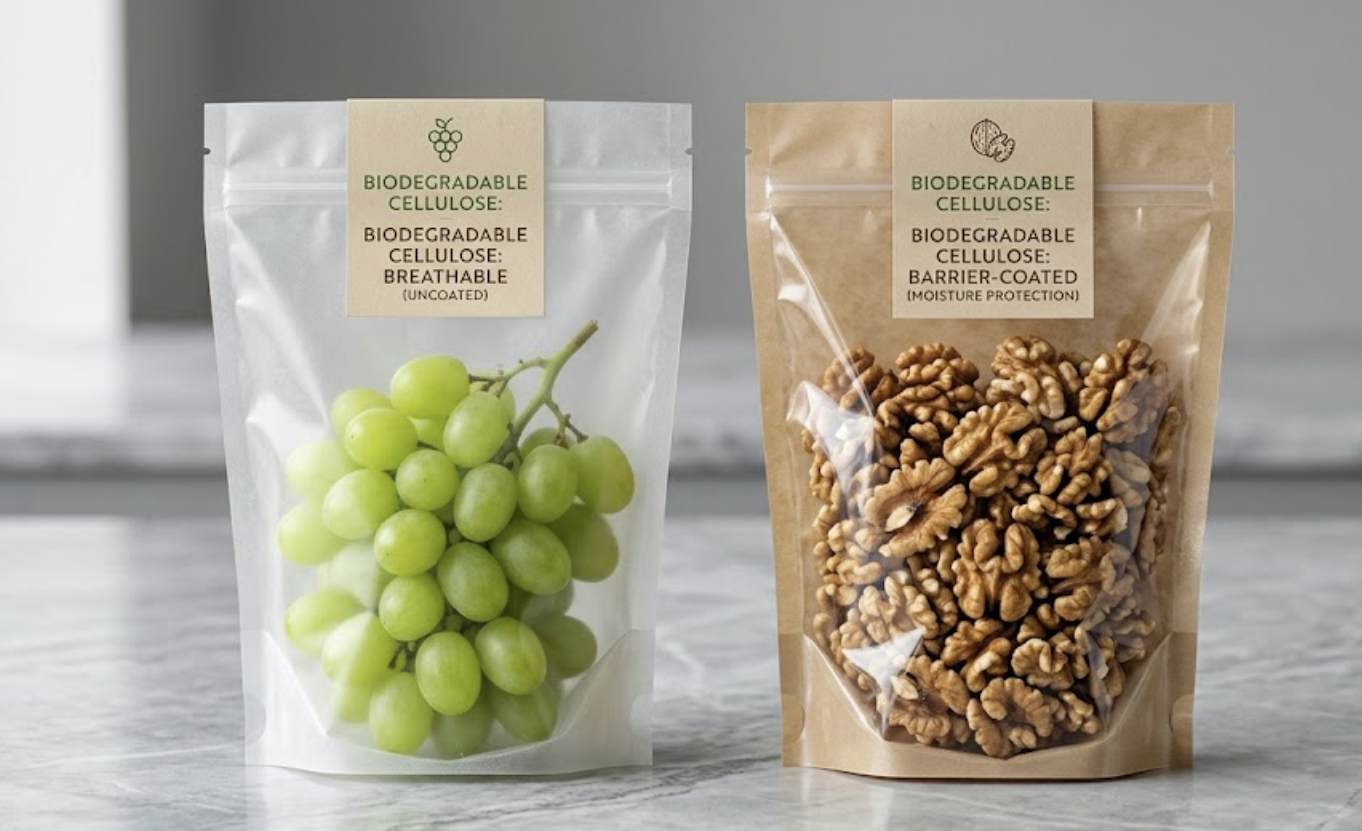
Why Moisture Barrier Performance Defines Cellulose Bag Application Boundaries
Water vapor transmission rate, commonly abbreviated as WVTR, measures how much water vapor passes through a film over a defined time period under controlled temperature and humidity conditions. The metric directly determines what products a cellulose bag can preserve and for how long. Fresh produce requires controlled moisture exchange to prevent both dehydration and condensation. Dry goods such as nuts, cookies, and tea demand low WVTR to maintain crispness and prevent staling. Non-food applications including textiles and gifts often tolerate higher WVTR without functional consequence.
Cellulose film occupies a distinctive position among packaging materials because its inherent semi-permeability creates both opportunities and limitations. Unlike fully sealed synthetic films such as BOPP, cellulose breathes at a measurable rate, which suits products requiring humidity regulation but presents challenges for moisture-sensitive applications. The standardized measurement methodologies, primarily ASTM E96 and ISO 2528, quantify this behavior under conditions designed to approximate real storage environments, typically at 38 degrees Celsius and 90 percent relative humidity.
WVTR data therefore serves as the foundational specification for application matching. Buyers who request and interpret this data accurately can predict shelf performance with reasonable confidence. Those who rely on general descriptions like "moisture resistant" or "breathable" often discover application mismatches only after product reaches retail.
Coated vs Uncoated Cellulose Films — The Performance Gap Quantified
Uncoated cellulose film typically exhibits WVTR values in the range of 400 to 800 grams per square meter per 24 hours under standard test conditions. This relatively high permeability suits applications where moisture exchange supports product quality, such as fresh bakery items or floral wraps, but proves inadequate for products requiring extended dry storage.
Coating treatments transform this performance profile substantially. Nitrocellulose coatings can reduce WVTR to between 20 and 50 grams per square meter per 24 hours, representing roughly a tenfold improvement. PVDC coatings push performance further, with WVTR values often below 10 grams per square meter per 24 hours, approaching the barrier performance of conventional plastic films. Biopolymer coatings derived from PLA or modified starch offer intermediate performance, generally in the 50 to 150 grams per square meter per 24 hours range, while maintaining stronger compostability credentials.
Critically, coating thickness affects both barrier performance and compostability timelines in opposing directions. Thicker coatings improve moisture resistance but extend decomposition periods. Thinner coatings preserve faster degradation behavior but offer reduced barrier protection. This trade-off cannot be eliminated through formulation alone, which makes specification calibration the central engineering decision.
Degradation Timelines Across Environments — Lake Water vs Industrial Composting vs Soil
Degradation behavior varies dramatically based on environmental conditions, and a single film grade can produce timeline differences exceeding tenfold across different disposal pathways. Uncoated cellulose film decomposes within 10 to 30 days in freshwater aquatic environments, with marine conditions producing somewhat slower but still rapid breakdown. Industrial composting facilities, operating at 50 to 60 degrees Celsius with controlled moisture and microbial activity, generally achieve complete decomposition within 30 to 45 days for uncoated film.
Coated cellulose film follows different patterns. Nitrocellulose-coated variants typically require 80 to 120 days for complete degradation in industrial composting conditions, with home composting timelines extending to six months or longer. PVDC coatings extend degradation significantly further, sometimes to the point where the underlying cellulose decomposes while coating fragments persist. Biopolymer-coated variants split the difference, generally achieving decomposition within 90 to 180 days depending on coating thickness and composting conditions.
Soil burial produces yet another performance curve. Uncoated cellulose decomposes within 60 to 90 days under typical soil conditions, while coated variants may require six months or more. The measurement methodology behind these timelines combines mass loss tracking, visual integrity assessment, and ecotoxicity testing of resulting residue. Real-world variance often exceeds laboratory measurements because temperature fluctuation, microbial population density, and oxygen availability all influence actual breakdown speed.
Structural Integrity Under Mechanical and Environmental Stress
Tensile strength in cellulose film varies considerably across humidity ranges. Dry cellulose at 20 percent relative humidity exhibits high tensile strength but lower elongation, which translates to crisp handling characteristics but reduced tear resistance. At 65 percent relative humidity, the film softens, with tensile strength decreasing while flexibility improves. Above 80 percent humidity, structural performance declines further, which affects bag integrity during humid storage or transit.
Puncture resistance and tear propagation behavior also depend on humidity conditioning. Film thickness influences performance, with standard cellulose bag production ranging from 21 to 40 microns depending on application. 31 microns represents our most commonly supplied standard thickness, offering a balanced combination of tensile strength, flexibility, and cost efficiency that suits the majority of everyday packaging needs. Thinner films suit lightweight applications such as floral wraps and produce stickers, while thicker films support heavier contents and longer storage periods.
YiTo Pack calibrates film specifications against expected handling conditions during the consultation phase, with thickness selection informed by product weight, transit distance, and destination climate. Stronger is not always better; over-specifying thickness can delay environmental decomposition without proportional structural benefit for the application.
Mapping Performance Profiles to Product Category Suitability
Food applications divide into distinct performance categories. Dry goods such as cookies, nuts, and tea require coated cellulose with WVTR below 50 grams per square meter per 24 hours, since moisture migration directly affects shelf life and product quality. Fresh produce, by contrast, benefits from uncoated cellulose where controlled moisture exchange supports respiration without trapping condensation. Confectionery typically falls between these extremes, with light coatings providing sufficient barrier protection while maintaining acceptable compostability timelines.
Non-food applications expand the suitable range considerably. Textiles and gifts tolerate higher WVTR without functional consequence, which means uncoated cellulose provides adequate performance at lower cost and faster degradation. Industrial uses such as bundling and protective wrapping generally prioritize structural integrity over barrier performance.
Storage duration further refines the matching exercise. Short-term scenarios under 30 days suit uncoated film for most applications, since moisture exposure remains limited. Storage periods between three and twelve months require coated variants, with coating selection calibrated against the specific moisture sensitivity of the product. Custom cellulose bag specifications developed for specific buyer applications often combine these variables, with film thickness, coating type, and bag dimensions adjusted to match documented use cases rather than generic categories.
How Buyers Should Read Performance Specifications During Sourcing
Several questions surface real performance data versus marketing claims during supplier evaluation. Asking for WVTR values measured under specified test conditions, rather than general descriptions of barrier performance, clarifies whether the supplier maintains actual testing infrastructure. Requesting degradation timeline data referenced to specific environmental conditions distinguishes documented performance from approximate claims.
Batch-level testing matters more than catalog specifications because production variation affects real-world performance. A film grade tested once during product development may perform differently across subsequent production runs if coating application or substrate sourcing varies. Buyers conducting serious supplier evaluation should request performance data tied to specific production batches rather than general product line specifications.
Independent laboratory verification adds an additional confirmation layer for high-stakes applications. Third-party testing of supplier-submitted samples removes potential bias from supplier-generated data and provides defensible documentation for downstream brand decisions. The combination of supplier batch data and periodic independent verification creates a verification framework appropriate for premium applications where performance failure carries significant commercial consequences.
Cellulose bag sourcing in 2026 rewards buyers who treat moisture barrier and degradation data as the foundation of product-application matching rather than peripheral specifications. The performance gap between uncoated and coated cellulose, combined with the dramatic timeline variation across disposal environments, means that material selection determines both shelf performance and sustainability outcomes simultaneously. YiTo Pack provides performance documentation and technical consultation services for buyers evaluating cellulose bag programs, with further information accessible through https://www.yitopack.com/.
Why Moisture Barrier Performance Defines Cellulose Bag Application Boundaries
Water vapor transmission rate, commonly abbreviated as WVTR, measures how much water vapor passes through a film over a defined time period under controlled temperature and humidity conditions. The metric directly determines what products a cellulose bag can preserve and for how long. Fresh produce requires controlled moisture exchange to prevent both dehydration and condensation. Dry goods such as nuts, cookies, and tea demand low WVTR to maintain crispness and prevent staling. Non-food applications including textiles and gifts often tolerate higher WVTR without functional consequence.
Cellulose film occupies a distinctive position among packaging materials because its inherent semi-permeability creates both opportunities and limitations. Unlike fully sealed synthetic films such as BOPP, cellulose breathes at a measurable rate, which suits products requiring humidity regulation but presents challenges for moisture-sensitive applications. The standardized measurement methodologies, primarily ASTM E96 and ISO 2528, quantify this behavior under conditions designed to approximate real storage environments, typically at 38 degrees Celsius and 90 percent relative humidity.
WVTR data therefore serves as the foundational specification for application matching. Buyers who request and interpret this data accurately can predict shelf performance with reasonable confidence. Those who rely on general descriptions like "moisture resistant" or "breathable" often discover application mismatches only after product reaches retail.
Coated vs Uncoated Cellulose Films — The Performance Gap Quantified
Uncoated cellulose film typically exhibits WVTR values in the range of 400 to 800 grams per square meter per 24 hours under standard test conditions. This relatively high permeability suits applications where moisture exchange supports product quality, such as fresh bakery items or floral wraps, but proves inadequate for products requiring extended dry storage.
Coating treatments transform this performance profile substantially. Nitrocellulose coatings can reduce WVTR to between 20 and 50 grams per square meter per 24 hours, representing roughly a tenfold improvement. PVDC coatings push performance further, with WVTR values often below 10 grams per square meter per 24 hours, approaching the barrier performance of conventional plastic films. Biopolymer coatings derived from PLA or modified starch offer intermediate performance, generally in the 50 to 150 grams per square meter per 24 hours range, while maintaining stronger compostability credentials.
Critically, coating thickness affects both barrier performance and compostability timelines in opposing directions. Thicker coatings improve moisture resistance but extend decomposition periods. Thinner coatings preserve faster degradation behavior but offer reduced barrier protection. This trade-off cannot be eliminated through formulation alone, which makes specification calibration the central engineering decision.
Degradation Timelines Across Environments — Lake Water vs Industrial Composting vs Soil
Degradation behavior varies dramatically based on environmental conditions, and a single film grade can produce timeline differences exceeding tenfold across different disposal pathways. Uncoated cellulose film decomposes within 10 to 30 days in freshwater aquatic environments, with marine conditions producing somewhat slower but still rapid breakdown. Industrial composting facilities, operating at 50 to 60 degrees Celsius with controlled moisture and microbial activity, generally achieve complete decomposition within 30 to 45 days for uncoated film.
Coated cellulose film follows different patterns. Nitrocellulose-coated variants typically require 80 to 120 days for complete degradation in industrial composting conditions, with home composting timelines extending to six months or longer. PVDC coatings extend degradation significantly further, sometimes to the point where the underlying cellulose decomposes while coating fragments persist. Biopolymer-coated variants split the difference, generally achieving decomposition within 90 to 180 days depending on coating thickness and composting conditions.
Soil burial produces yet another performance curve. Uncoated cellulose decomposes within 60 to 90 days under typical soil conditions, while coated variants may require six months or more. The measurement methodology behind these timelines combines mass loss tracking, visual integrity assessment, and ecotoxicity testing of resulting residue. Real-world variance often exceeds laboratory measurements because temperature fluctuation, microbial population density, and oxygen availability all influence actual breakdown speed.
Structural Integrity Under Mechanical and Environmental Stress
Tensile strength in cellulose film varies considerably across humidity ranges. Dry cellulose at 20 percent relative humidity exhibits high tensile strength but lower elongation, which translates to crisp handling characteristics but reduced tear resistance. At 65 percent relative humidity, the film softens, with tensile strength decreasing while flexibility improves. Above 80 percent humidity, structural performance declines further, which affects bag integrity during humid storage or transit.
Puncture resistance and tear propagation behavior also depend on humidity conditioning. Film thickness influences performance, with standard cellulose bag production ranging from 21 to 40 microns depending on application. 31 microns represents our most commonly supplied standard thickness, offering a balanced combination of tensile strength, flexibility, and cost efficiency that suits the majority of everyday packaging needs. Thinner films suit lightweight applications such as floral wraps and produce stickers, while thicker films support heavier contents and longer storage periods.
YiTo Pack calibrates film specifications against expected handling conditions during the consultation phase, with thickness selection informed by product weight, transit distance, and destination climate. Stronger is not always better; over-specifying thickness can delay environmental decomposition without proportional structural benefit for the application.
Mapping Performance Profiles to Product Category Suitability
Food applications divide into distinct performance categories. Dry goods such as cookies, nuts, and tea require coated cellulose with WVTR below 50 grams per square meter per 24 hours, since moisture migration directly affects shelf life and product quality. Fresh produce, by contrast, benefits from uncoated cellulose where controlled moisture exchange supports respiration without trapping condensation. Confectionery typically falls between these extremes, with light coatings providing sufficient barrier protection while maintaining acceptable compostability timelines.
Non-food applications expand the suitable range considerably. Textiles and gifts tolerate higher WVTR without functional consequence, which means uncoated cellulose provides adequate performance at lower cost and faster degradation. Industrial uses such as bundling and protective wrapping generally prioritize structural integrity over barrier performance.
Storage duration further refines the matching exercise. Short-term scenarios under 30 days suit uncoated film for most applications, since moisture exposure remains limited. Storage periods between three and twelve months require coated variants, with coating selection calibrated against the specific moisture sensitivity of the product. Custom cellulose bag specifications developed for specific buyer applications often combine these variables, with film thickness, coating type, and bag dimensions adjusted to match documented use cases rather than generic categories.
How Buyers Should Read Performance Specifications During Sourcing
Several questions surface real performance data versus marketing claims during supplier evaluation. Asking for WVTR values measured under specified test conditions, rather than general descriptions of barrier performance, clarifies whether the supplier maintains actual testing infrastructure. Requesting degradation timeline data referenced to specific environmental conditions distinguishes documented performance from approximate claims.
Batch-level testing matters more than catalog specifications because production variation affects real-world performance. A film grade tested once during product development may perform differently across subsequent production runs if coating application or substrate sourcing varies. Buyers conducting serious supplier evaluation should request performance data tied to specific production batches rather than general product line specifications.
Independent laboratory verification adds an additional confirmation layer for high-stakes applications. Third-party testing of supplier-submitted samples removes potential bias from supplier-generated data and provides defensible documentation for downstream brand decisions. The combination of supplier batch data and periodic independent verification creates a verification framework appropriate for premium applications where performance failure carries significant commercial consequences.
Cellulose bag sourcing in 2026 rewards buyers who treat moisture barrier and degradation data as the foundation of product-application matching rather than peripheral specifications. The performance gap between uncoated and coated cellulose, combined with the dramatic timeline variation across disposal environments, means that material selection determines both shelf performance and sustainability outcomes simultaneously. YiTo Pack provides performance documentation and technical consultation services for buyers evaluating cellulose bag programs, with further information accessible through https://www.yitopack.com/.
HuiZhou YITO Packaging Co., Ltd.
+ +86 15975086317
email us here
Visit us on social media:
LinkedIn
Instagram
Facebook
YouTube
Legal Disclaimer:
EIN Presswire provides this news content "as is" without warranty of any kind. We do not accept any responsibility or liability for the accuracy, content, images, videos, licenses, completeness, legality, or reliability of the information contained in this article. If you have any complaints or copyright issues related to this article, kindly contact the author above.

