

Brewing Enzymes Market to Reach USD 1,287.45 Million by 2035, Growing at 7.98% CAGR
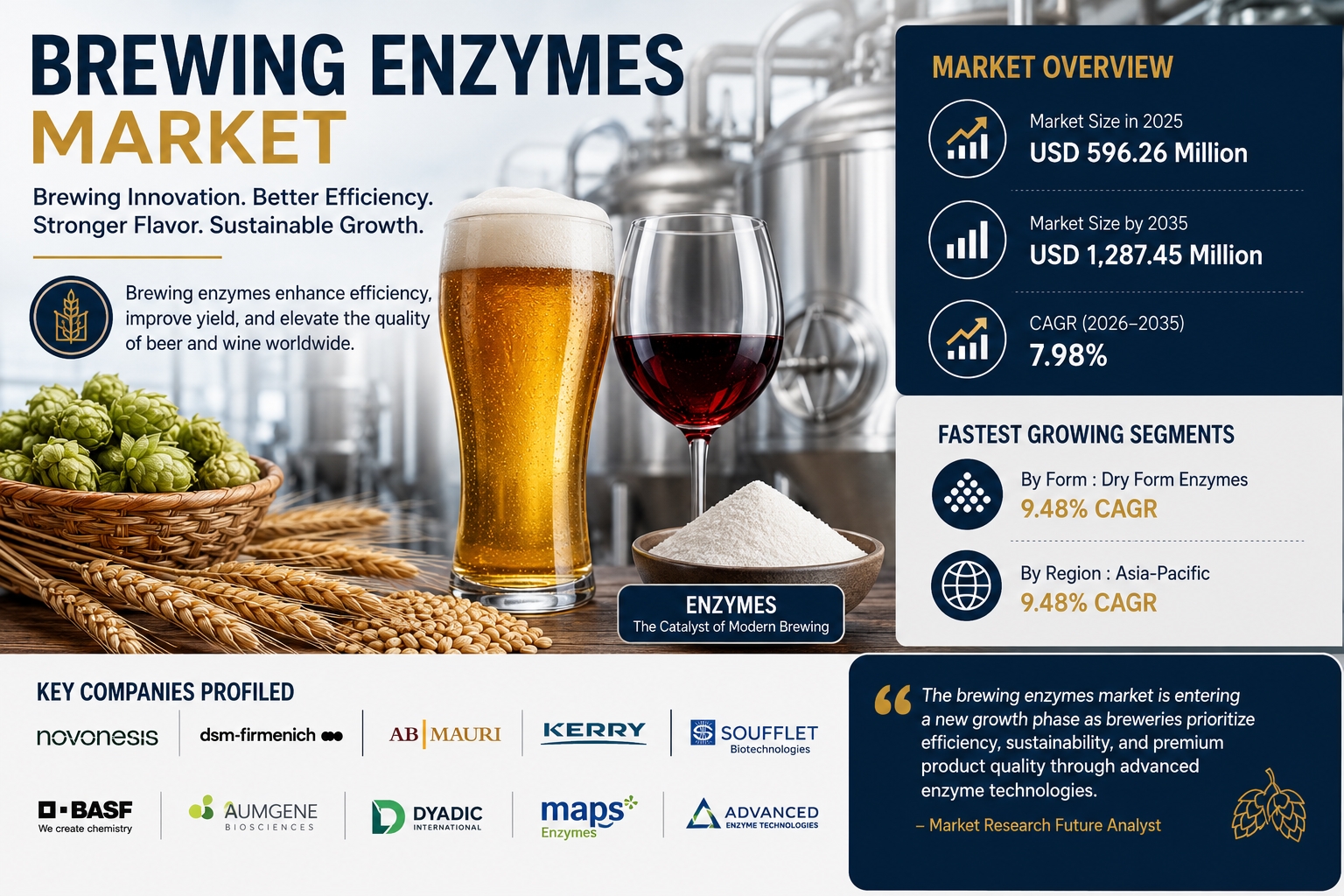
Brewing Enzymes Market
Rising beer and wine production, dry-form innovation, and Asia-Pacific expansion are driving strong global demand for brewing enzymes.
The brewing enzymes market is entering a new growth phase as breweries prioritize efficiency, sustainability, and premium product quality through advanced enzyme technologies.”
NEW YORK, NY, UNITED STATES, July 16, 2026 /EINPresswire.com/ -- The global Brewing Enzymes Market is entering a sustained growth phase as breweries and winemakers increasingly adopt enzyme-based solutions to improve process efficiency, product quality, sustainability, and consistency. According to Market Research Future, the market was valued at USD 596.26 million in 2025 and is projected to reach USD 1,287.45 million by 2035, expanding at a CAGR of 7.98% during 2026–2035. The market covers the production, sale, and application of enzymes used in beer and wine production.— Market Research Future (MRFR)
The study period from 2021 to 2035 captures a major transformation in the beverage industry, where brewing enzymes are moving from a supporting ingredient category to a strategic production tool. As brewers face pressure to deliver high-quality products with lower energy use, reduced water consumption, shorter production cycles, and more predictable fermentation outcomes, enzymes have become an essential part of modern brewing strategies. In parallel, changing consumer preferences for specialty beers, gluten-free variants, low-alcohol products, and premium wines are encouraging producers to adopt advanced enzymatic tools that support formulation flexibility and process control.
Key Market Highlights
The Brewing Enzymes Market is being shaped by several high-value growth indicators that point to long-term expansion across both industrial and craft beverage production.
Market size in 2025: USD 596.26 million
Market size in 2035: USD 1,287.45 million
Forecast CAGR: 7.98% from 2026 to 2035
Fastest-growing form: Dry-form enzymes at 9.48% CAGR
Fastest-growing region: Asia-Pacific at 9.48% CAGR
Largest application: Beer production with 92.18% share in 2025
Fastest-growing application: Wine at 9.42% CAGR
Leading source category: Microbial enzymes with 78.72% share in 2025
Largest regional market: Europe with 35.78% share in 2025
North America share: 27.14% in 2025
These figures reflect a market that is not only expanding in size, but also becoming more specialized, more efficient, and more closely aligned with the operational needs of modern beverage producers.
Get Full PDF Sample Copy of Report: (Including Full TOC, List of Tables & Figures, Chart) @ https://www.marketresearchfuture.com/sample_request/6331
Why Brewing Enzymes Are Gaining Momentum
Brewing enzymes are increasingly valued for their ability to improve mash conversion, optimize fermentation, enhance filtration, break down unwanted compounds, and boost yield without compromising product quality. Across large-scale industrial breweries and smaller craft operations alike, enzyme usage is helping manufacturers reduce dependence on traditional process workarounds while improving consistency from batch to batch. This is particularly relevant in markets where ingredient variability, climate conditions, and regional raw material differences can influence brewing performance.
The growing importance of enzymes is also tied to the broader shift toward precision brewing. Producers are under pressure to achieve tighter control over attenuation, clarity, mouthfeel, and flavor stability while also reducing waste and improving throughput. Enzymes help address these goals by enabling more efficient starch breakdown, better protein management, improved filtration behavior, and more reliable fermentation performance. For breweries operating in highly competitive markets, these advantages can translate into stronger margins, faster production cycles, and more consistent product quality.
Dry-Form Enzymes Emerge as a High-Growth Segment
One of the defining trends in the Brewing Enzymes Market is the rise of dry-form enzymes, which represent the fastest-growing form category with a 9.48% CAGR through the forecast period. Dry formulations are gaining momentum because they offer shelf stability, simpler storage, lower shipping costs, and reduced dependence on cold-chain logistics. These advantages are especially useful for breweries operating in remote or tropical regions, as well as for producers seeking efficient inventory management and longer product life.
Liquid enzymes still account for a major share of the market because of their compatibility with automated dosing systems and in-line injection processes, but dry formulations are expected to capture expanding attention as technology improves and supply-chain efficiency becomes more important. Their convenience also makes them attractive to smaller breweries and wineries that may not have the same infrastructure as large industrial producers. As logistics costs rise and sustainability expectations increase, dry-form enzymes are likely to become even more important in global distribution strategies.
Source Trends: Microbial Enzymes Lead the Market
In terms of source, microbial enzymes continue to dominate the market, accounting for an estimated 78.72% share in 2025. Their dominance reflects the scalability, consistency, and industrial reliability of fermentation-derived enzyme production. Microbial enzymes are widely used because they can be manufactured in controlled environments, tailored for specific brewing functions, and produced at commercial scale with predictable performance.
Plant-based enzymes are also gaining traction as clean-label and organic brewing preferences continue to advance. This shift reflects a broader movement toward ingredient transparency and sustainable sourcing across the beverage industry, particularly among premium brands and health-conscious consumers. As breweries and wineries seek to align with consumer expectations around natural ingredients and environmentally responsible production, the demand for alternative enzyme sources is expected to rise steadily. This trend is especially relevant in premium and specialty beverage categories, where ingredient story and product positioning can influence purchasing decisions.
Application Insights: Beer Dominates, Wine Accelerates
By application, beer production remains the backbone of the market, representing an estimated 92.18% share in 2025. That scale reflects the sheer volume of global beer output and the wide use of enzymes in mashing, clarification, filtration, and fermentation optimization. Brewing enzymes are widely used to improve extract yield, reduce haze formation, support starch conversion, and enhance process efficiency across a broad range of beer styles.
Wine applications, however, are emerging as a high-growth opportunity, with a projected 9.42% CAGR. Winemakers are increasingly using enzymes such as pectinases and glucanases to improve extraction, clarification, and filtration performance, while also supporting premium quality goals and more efficient cellar operations. The overlap between brewing and winemaking applications is creating a broader enzymatic toolkit for beverage manufacturers that operate across both categories. This convergence is particularly valuable for producers seeking to diversify portfolios, improve cellar productivity, and maintain consistent quality across multiple beverage lines.
Regional Outlook: Europe Leads, Asia-Pacific Expands Fastest
Regionally, the market shows a clear growth contrast between mature and emerging geographies. Europe holds the largest regional share at 35.78% in 2025, supported by strong sustainability compliance requirements, advanced brewing technologies, and precision fermentation activity. The region’s established brewing culture, combined with its focus on process optimization and environmental performance, continues to support strong enzyme adoption.
North America follows with a 27.14% share, driven by craft brewery enzyme adoption, gluten-free innovation, and a mature innovation ecosystem. The region’s dynamic craft brewing sector has created strong demand for flexible process aids that support experimentation, style differentiation, and product customization. Breweries in the United States and Canada are increasingly using enzymes to improve efficiency while also responding to consumer demand for specialty and health-oriented beverages.
Asia-Pacific, however, is expected to be the fastest-growing regional market with a 9.48% CAGR, fueled by volume expansion, new brewery commissioning, rising consumer demand, and rapid development in countries such as China and India. Other regions such as the Middle East & Africa and South America are also expanding steadily, reflecting modernization of local brewing systems and greater adoption of enzymatic production methods.
Within Asia-Pacific, growth is being accelerated by macro-brewery standardization in China, a microbrewery boom in India, and rising premium beverage consumption across several markets. Europe’s leadership is anchored in long-standing brewing traditions, but the region is also embracing innovation in sustainability, process efficiency, and ingredient precision. North America continues to benefit from a dynamic craft brewing segment, where brewers are using enzymes to support product differentiation, style experimentation, and gluten-free formulation.
Competitive Landscape and Innovation
The market’s forward momentum is also supported by a strong competitive landscape. Market Research Future profiles ten major companies shaping the industry, including Novonesis, DSM-Firmenich, AB Enzymes, Kerry Group, Soufflet Biotechnologies, BASF, Aumgene Biosciences, Dyadic International, Maps Enzymes, and Advanced Enzyme Technologies. Novonesis, formerly Novozymes, remains a leading player in amylase mashing and glucanase beer filtration solutions, while DSM-Firmenich has strengthened its position through integrated nutrition-enzyme platforms. AB Enzymes continues to hold a strong European presence as a specialist in brewing applications.
Innovation is also reshaping the competitive environment. New product development is increasingly centered on multi-enzyme blends, improved thermostability, higher yield performance, and enzyme systems designed for modern high-adjunct brewing. Recent market developments include the launch of advanced enzyme blends aimed at improving brewing efficiency in large-scale Asian production environments, as well as investments in fermentation capacity dedicated to brewing-grade enzymes. These moves reflect rising demand for solutions that can deliver measurable operational benefits while helping breweries meet cost and sustainability targets.
Competition is increasingly defined by technical performance, formulation flexibility, and the ability to support customer-specific brewing goals. Companies that can deliver enzymes with stronger stability profiles, better compatibility with diverse raw materials, and improved performance under variable process conditions are likely to gain a stronger foothold. At the same time, partnerships with breweries, wineries, and ingredient distributors are becoming more important as manufacturers seek localized support and faster product deployment.
Industry Drivers Supporting Long-Term Growth
Several broader industry trends are reinforcing this growth. First, global beer consumption remains resilient, even as product mix shifts toward specialty and premium offerings. Second, independent breweries continue to expand in many markets, increasing demand for flexible process aids and scalable ingredient systems. Third, sustainability mandates are pushing producers to reduce energy, water, and waste intensity across brewing operations. Enzymes help support these objectives by improving conversion efficiency and lowering the resource burden associated with traditional process methods.
Specialty beer demand is another key driver. Gluten-free, low-alcohol, and highly differentiated beer styles require precise process control and ingredient optimization. Brewing enzymes play a major role in enabling these formulations by modifying starch conversion, improving clarity, managing protein levels, and supporting fermentation outcomes tailored to product goals. As consumer expectations become more sophisticated, enzyme innovation is becoming inseparable from product innovation.
The market is also benefiting from the growing need for operational resilience. Breweries and wineries are increasingly exposed to raw material variability, climate-related disruptions, and shifting regulatory expectations. Enzymes provide a practical way to stabilize production outcomes and maintain quality standards even when ingredient profiles change. This makes them especially valuable in regions where barley, wheat, grapes, and other inputs may vary significantly from season to season.
Outlook Through 2035
The market outlook remains highly favorable over the forecast period. With the industry expected to nearly double from USD 596.26 million in 2025 to USD 1,287.45 million in 2035, the Brewing Enzymes Market is positioned for a decade of durable expansion. The strongest opportunities will likely emerge for companies that combine advanced enzyme science with cost-effective formulation, regulatory readiness, sustainable manufacturing, and close alignment to brewery operational needs. Dry-form products, Asia-Pacific expansion, and wine-processing adoption are expected to be especially important growth vectors.
As the global beverage industry continues to evolve, brewing enzymes are transitioning from a technical input to a strategic enabler. Their role now extends beyond efficiency gains to include quality enhancement, sustainability support, and product differentiation. For brewers and winemakers navigating a more competitive and more demanding market, enzymes are becoming a practical solution for achieving consistency, flexibility, and long-term scalability.
Discover Related Research Reports By Market Research Future:
Chocolate Beer Market
https://www.marketresearchfuture.com/reports/chocolate-beer-market-4994
Bakery Enzymes Market
https://www.marketresearchfuture.com/reports/bakery-enzymes-market-5214
Feed Enzymes Market
https://www.marketresearchfuture.com/reports/feed-enzymes-market-5130
Sagar Kadam
Market Research Future
+1 628-258-0071
email us here
Legal Disclaimer:
EIN Presswire provides this news content "as is" without warranty of any kind. We do not accept any responsibility or liability for the accuracy, content, images, videos, licenses, completeness, legality, or reliability of the information contained in this article. If you have any complaints or copyright issues related to this article, kindly contact the author above.
