

Your food and beverage industry news reporter
Provided by AGP
As Automation Reshapes Specialty Beverage Retail, Robotic Cafe Concepts Move From Novelty to Mainstream Infrastructure
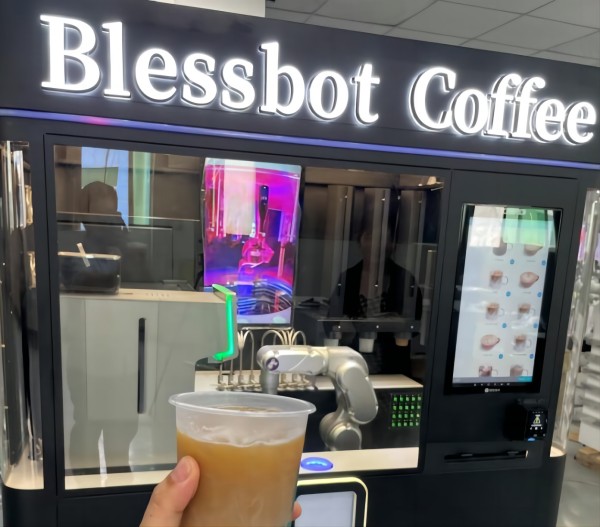
For most of the past two decades, the specialty beverage industry — espresso bars, boutique tea shops, craft juice counters — has been defined by a peculiar contradiction. On one hand, it is one of the fastest-growing categories in global retail, with specialty coffee alone projected to surpass $150 billion by 2030. On the other hand, it remains one of the most labor-dependent, real-estate-hungry, and operationally fragile sectors in consumer retail. A single barista calling in sick can shutter a location. A 200-square-meter lease in a Tier-1 city can consume an entire year's profit. And training a staff member to pull consistent espresso, let alone produce latte art, takes months.
That contradiction is now breaking. Across Asia, Europe, and increasingly North America, operators are quietly rethinking the unit economics of the beverage counter itself. The shift is not cosmetic — it is structural. Footprints are shrinking from full-service cafés to four-square-meter kiosks. Labor is being redistributed from preparation to supervision. And the definition of what counts as a "premium" cup is being rewritten by machines that can replicate, with measurable consistency, what was once considered an artisanal skill. The industry is moving, in other words, from craft scarcity to engineered abundance.
Why Automation Is No Longer the Fringe Conversation
Three converging pressures explain why robotics has moved from trade-show curiosity to boardroom agenda. The first is wage inflation. In markets from Seoul to San Francisco, hourly café labor costs have risen 30–60% over five years, while menu prices have not kept pace. The second is real estate compression: post-pandemic landlords are favoring high-yield, low-footprint tenants — vending-style and kiosk formats that generate revenue per square meter at multiples of traditional cafés. The third, and least discussed, is consistency expectation. Consumers conditioned by app-based ordering and global chain standardization no longer tolerate the "bad cup" variance that defined indie cafés a decade ago.
Together, these forces have made the question facing operators today not whether to automate, but which layer of automation matches their format. Self-service espresso machines solved part of the problem. Conveyor-style bean-to-cup units solved another. But the highest-margin, highest-engagement segment — the latte art cappuccino, the customized printed-foam drink, the Instagram-ready beverage — has historically resisted automation because it required dexterity, vision, and creative variability that machines could not deliver. That barrier is now falling, and with it, the last argument for keeping the specialty counter manual.
From Demonstration Units to Deployable Infrastructure
What separates the current wave of beverage robotics from the gimmick generation of 2017–2020 is repeatability. Early robotic cafe installations drew crowds but failed commercially because they were engineered as showpieces — fragile, slow, and expensive to maintain. The second generation, now reaching commercial maturity, treats the robotic coffee shop as infrastructure: a sealed, standardized, remotely monitored production unit designed to run 24 hours a day, 365 days a year, with predictable consumable costs and machine-vision-driven quality control.
One illustrative example of this transition is RobotAnno (Anno Robotics, Shenzhen), a national high-tech enterprise founded in 2017 that has built its product line around desktop-grade robotic arms and AI embodied-intelligence applications for retail. The company holds more than 80 national patents on its arm and control systems, has shipped to over 70 countries and 100+ Chinese cities, and was recognized by CCTV's flagship news program as a benchmark intelligent-manufacturing enterprise. None of those credentials matter on their own — what matters is what they signal about the category: robotic beverage retail is no longer being prototyped, it is being industrialized at scale.
The company's most recent release, an enclosed single-arm latte-art and print-coffee kiosk that won the 2025 AI Tianma Award, is instructive as a case study in how the format is converging. A six-axis arm, high-precision machine vision, 3D modeling, and a learning system together replicate professional latte-art technique in roughly 90 seconds per cup. The same enclosure handles hot and cold coffee, printed foam imagery, juices, light milk teas, and chocolate beverages — 26-plus customizable SKUs from a footprint of under 2.5 square meters. Operators interested in the engineering specifications and deployment models can review the technical documentation at www.annorobots.com, but the strategic point is broader: a single enclosed unit now performs the work of a three-person specialty bar, with output variance measured in milliliters rather than mood.
The New Unit Economics: Why Operators Are Recalculating
For franchise developers, hospitality groups, and independent investors evaluating where to deploy capital, the math has shifted decisively. A traditional specialty café in a Tier-1 location typically requires $150,000–$400,000 in build-out, three to five staff per shift, and 18–36 months to break even. A robotic kiosk in the same traffic zone requires a fraction of the build-out, one part-time supervisor for restocking and cleaning, and operates continuously through nights, holidays, and labor shortages. When operators ask which is the best vending business to start in the current environment, the answer is increasingly not snacks or canned drinks — categories with thin margins and commodity competition — but freshly-made specialty beverages, where the gross margin per cup remains 65–75% and the perceived value is several multiples above packaged alternatives.
The deployment surface is also widening. These units are being placed not as replacements for flagship cafés but as extensions into venues that could never support a traditional café: airport gates, hospital lobbies, office tower elevator banks, cinema concourses, automotive showrooms, hotel mezzanines, museum atriums, university libraries, and high-speed rail stations. Each of these locations shares a profile — high foot traffic, restricted square footage, irregular demand peaks, and labor scarcity — that traditional café formats cannot economically serve but that an enclosed robotic unit serves natively.
Key Takeaways for Industry Operators
Automation is now a margin question, not a novelty question. The operators winning in 2025 are not asking whether customers will accept a robot-made cup — that debate ended — but how quickly they can retrofit existing portfolios to capture the labor and footprint savings.
Latte art was the last technical moat, and it has fallen. Once machine vision and six-axis precision can replicate signature pours, the artisanal premium that justified manual specialty cafés narrows to ambiance and human ritual, not the drink itself.
Footprint flexibility is the new competitive weapon. A four-square-meter unit unlocks tens of thousands of viable retail locations that a 200-square-meter café cannot enter. The total addressable market for specialty beverages is being redrawn.
Data is the second product. Every robotic kiosk generates per-cup telemetry — flavor preferences, peak hours, ingredient usage, payment patterns — that traditional cafés never captured. Operators who treat this as a strategic asset will outmaneuver those who treat it as a back-office report.
The supervisory role is the new barista. Labor does not disappear; it shifts upward. One technician can oversee a network of units, turning what was a frontline hourly job into a higher-skilled, higher-leverage position.
What Comes Next: From Single Units to Networked Beverage Infrastructure
The next phase of this transition will not be defined by individual installations but by networks. Once a brand operates fifty or five hundred robotic kiosks under unified backend management — with remote monitoring, dynamic menu deployment, and real-time inventory orchestration — the economics begin to resemble cloud infrastructure more than retail. Menu changes propagate in minutes. A new seasonal SKU launches across continents in a single software push. Promotional pricing adapts to local foot traffic. Maintenance becomes predictive rather than reactive.
For industry practitioners, the strategic question is no longer "should we pilot a robot?" but "what is our position when 20% of specialty beverage volume in our market runs through automated infrastructure within five years?" Operators who view robotic cafe deployment as a side experiment will find themselves competing on cost structures they cannot match. Those who treat it as a core platform decision — integrated with their brand, data, supply chain, and real-estate strategy — will define the next decade of the category. The novelty era is closing. The infrastructure era has begun, and the operators who understand the difference are already building for it.
Anno Robot
RobotAnno(ShenZhen) Co., Ltd.
+86 16602860929
celine@annorobots.com
Visit us on social media:
LinkedIn
Facebook
YouTube
Legal Disclaimer:
EIN Presswire provides this news content "as is" without warranty of any kind. We do not accept any responsibility or liability for the accuracy, content, images, videos, licenses, completeness, legality, or reliability of the information contained in this article. If you have any complaints or copyright issues related to this article, kindly contact the author above.
